Tokyo (SCCIJ) – This luncheon with more than 60 members and guests of the Swiss chamber marked the 160th anniversary of diplomatic relations between Switzerland and Japan with a talk about Swiss watchmakers in Japan since 1864 by Pierre-Yves Donzé, Professor of Business History at Osaka University. He outlined the major phases in the development of Swiss watchmakers’ presence in the Japanese market from then until today. We summarize his talk in Q&A form.

SCCIJ June Luncheon Speaker Pierre-Yves Donzé, Professor of Business History at Osaka University.
The relationship between the Swiss and Japanese watchmaking industry has often been characterized as if they were adversaries and at war with each other. What is your assessment?
This popular description seems to be quite simplifying the actual history of relations which were “beyond the clash of nations.” Swiss entrepreneurs contributed to the emergence of a watch industry in Japan. For example, Swiss merchants sent Taiichi Mizunoi in 1885 to the Watchmaking School of Le Locle as the first Japanese to learn the watchmaking craft. However, Japanese companies also supported the expansion of Swiss watch brands in Japan as business and retail partners.
What were the reasons for such cooperation and mutual support?
Swiss and Japanese actors reacted to the changing environment, be it the growth and change
of consumption, or the introduction of new trade rules. For example, Swiss merchants recognized a new market when Japan as the last big country opened itself for global trade after the Meiji revolution and arrived quicker than potential rivals. Later, Japan wanted to develop its watch industry and used high tariffs to protect its market. Of course, not every Swiss merchant was happy about this. One of them denounced “the cunning of these yellow skins” in 1897 when the competition began to heat up.
And how does the famous “quartz revolution” or “quartz crisis”, depending on the actor’s view, fit into this picture?
The first commercial quartz wristwatch which was launched at the end of 1969 – the “Astron” made by Seiko – was the result of a fierce technological competition between two groups of Swiss and Japanese makers. The Neuchatel Observatory competition which measured the measurement accuracy of timepieces, excluded Seiko in 1971 because this Japanese company made watches more precise than Swiss companies – including mechanical watches.

June Luncheon Speaker Professor Donzé with Swiss Ambassador Dr. Andreas Baum (third from left), SCCIJ President Thomas Brodbeck (far right), and members and advisors of the Executive Committee.
Why were the Japanese the big beneficiaries of the quartz revolution?
Japanese producers like Seiko, Citizen, and Casio saw the quartz watch as an opportunity to expand the global watch market with this disruptive technology and conquer the market with cheap, mass-produced watches. Only after Swiss watch employment and the number of watchmakers fell sharply, did the two biggest Swiss watch groups merge to save the industry resulting in the formation of the Swatch Group.
Jumping back to the beginning of Swiss-Japanese watch relations, how would you describe the formative years in the second half of the 19th century?
After the Swiss merchants arrived in Yokohama in 1862, they had to develop a niche market. A watch was a completely new and rather expensive product. The Swiss partnered with Japanese merchants and targeted wealthy male elite members. Le Locle dominated this niche with makers like Nardin, Tissot, and Zenith. After about 20 years, the watch market expanded due to the introduction of the Western time system and calendar in 1873. The watch became a useful product. The national market grew from 190,000 annually sold watches in 1895 to 1 million pieces in 1920. In the beginning, all watches were imported from Switzerland, either via Swiss merchants or Japanese retailers. However, these imports fostered the localization of production. By 1920, about one-third of all sold watches were already produced in Japan, partly successful by using the cheaper material Nickel.
How did it happen then that Seiko became the world’s largest watchmaker after only a few decades?
On the one hand, this development came about through protective import tariffs after 1911. After the Great Kanto Earthquake of 1923, Seiko built a modern factory in 1928 and crowned itself as Japan’s watch king with the famous art deco building in Ginza in 1932 with a watch tower on top. Citizen Watch was founded in 1930. The Great Pacific War forced Japan to become technologically independent. Swiss watchmakers struggled to survive. Longines cooperated with Hattori from 1911 onwards, Omega had a contract with the trading company Siber Hegner (today’s DKSH) which worked closely with the retailer Osawa.
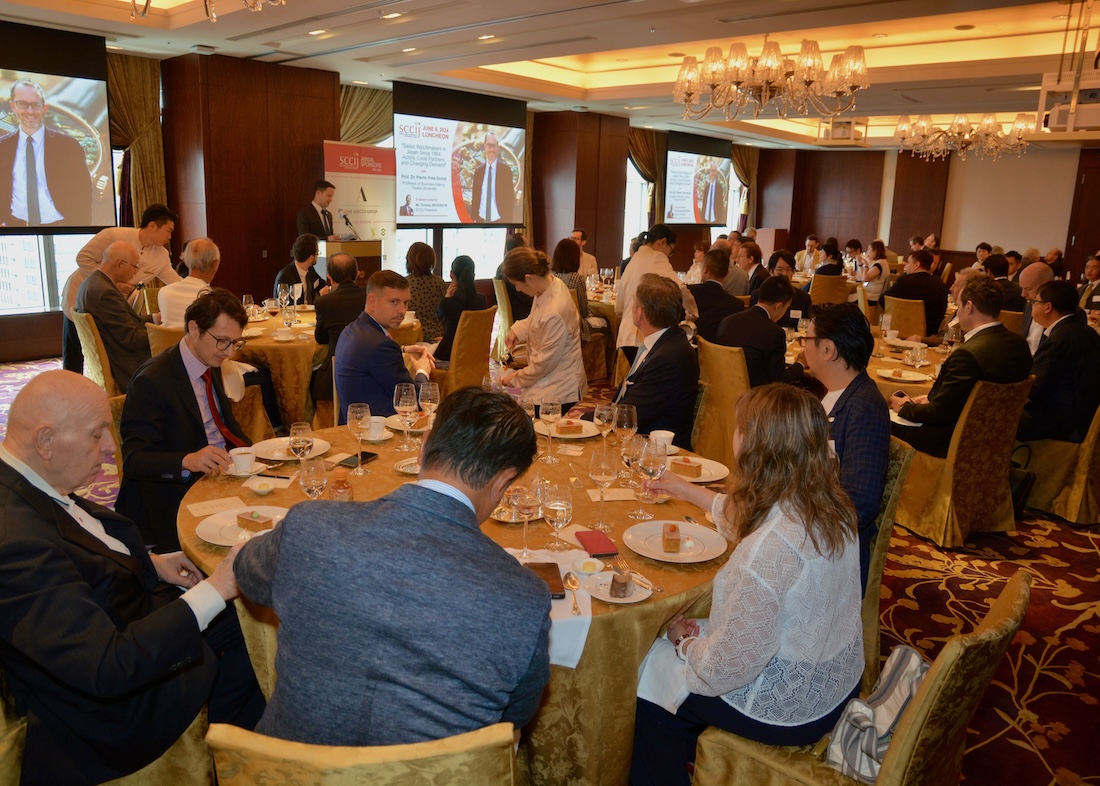
The SCCIJ June Luncheon at the Shangri-La Hotel was fully booked.
What happened to Swiss watchmakers in Japan after tariffs were liberalized in 1960?
They decided to slowly but steadily take full control of retail in Japan. They were cutting out intermediaries and ended distribution agreements. For example, Longines, the long-time supplier of Hattori, founded a Japanese subsidiary in 1974. Rolex followed in 1980. This brand had great success by using the American golfer Arnold Palmer as a brand ambassador starting in 1967.
And what is the state of Swiss-Japanese watch relations today?
The watchmaking industry went through the “luxury revolution” after 1990, bringing multinational enterprises like Richemont, a global market approach, and new marketing strategies positioning watches as luxury and fashion products. Big brands set up subsidiaries in Japan, Bulgari in 1991, Breitling in 1995, Tag Heuer in 1997, Cartier in 2003, and Chopard in 2006. Retail operations were verticalized and headquarters tightened their control. Swiss watches are now thoroughly entrenched in the segment above 3,000 francs and their market share in Japan is even higher than in the global market.
How did Japanese watchmakers react to these developments?
They had to overcome two challenges. One: After flooding the world market with cheap quartz watches, these producers had to build a luxury image from scratch. Two: They came late to the party because they relied on their dominance for too long. Today, they are still struggling to build luxury brands. For example, Seiko relaunched its high-end brand “Grand Seiko” in 2010 and founded Astron for high-tech watches and Presage for historical models. Casio developed its G-Shock brand but without demanding prices in the luxury realm.
About the speaker
Pierre-Yves Donzé is a professor of business history at Osaka University and a visiting professor at the University of Fribourg. He was the 2023 Thomas K. McCraw fellow at Harvard Business School and is secretary of the European Business History Association. His research focuses on creative industries (fashion, luxury, and watchmaking) and the history of multinational enterprises. His most recent book is “La fabrique de l’excellence: histoire de Rolex” (Neuchâtel: Alphil, 2024).