Tokyo (SCCIJ) – Researchers in Switzerland have boosted the efficiency of a promising new class of solar cells to a record high. They achieved a 30% power conversion rate, a world record for solar cells combining silicon and perovskite technology, opening the door to the next-generation photovoltaics.
Higher efficiency
The solar industry has been pushing the efficiency ceiling of conventional single-junction silicon photovoltaics for decades. These cells have become cheap and dominant. However, they convert only part of the solar spectrum into electricity. Perovskite-silicon technology offers a path to cheaper, lighter, and more efficient cells by capturing a broader range of the spectrum. The improvement reduces the number of panels needed for the same output, which matters for space-constrained rooftops, densely populated markets, satellites and high-value industrial applications.
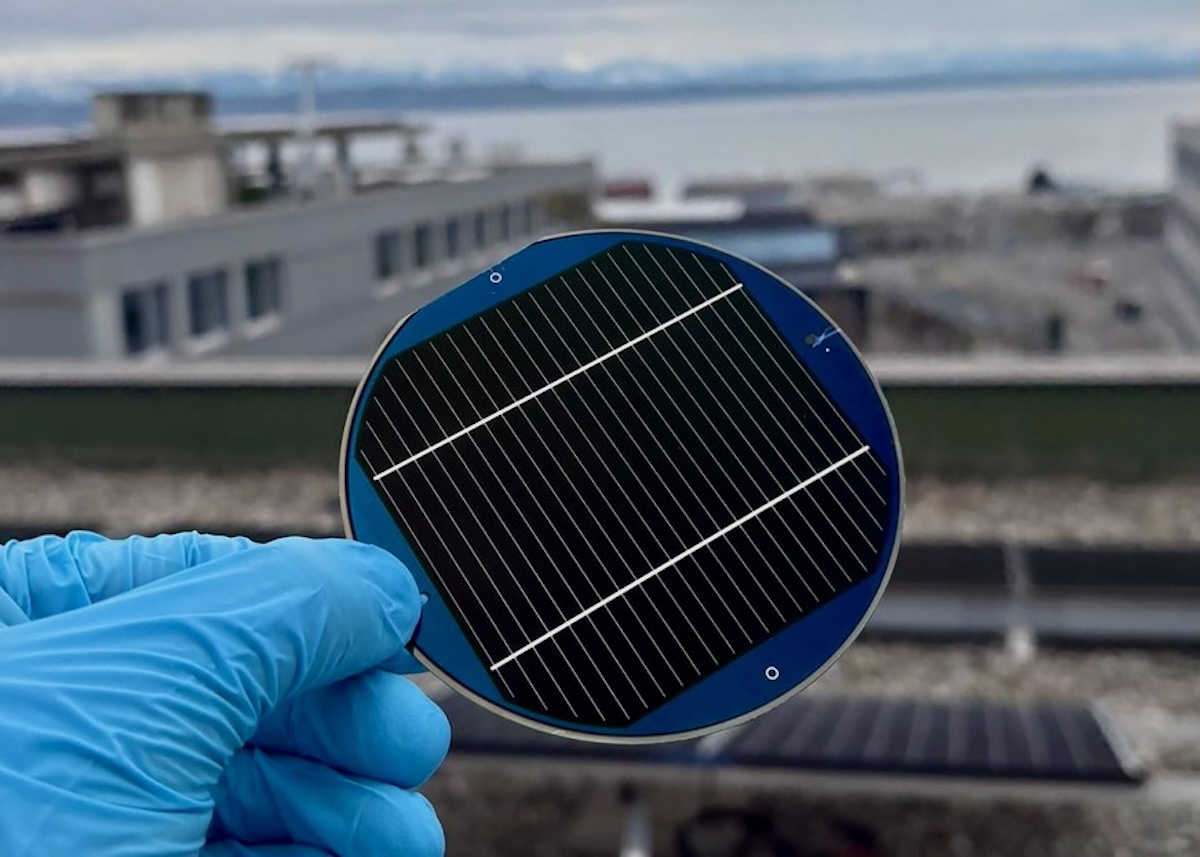
The perovskite-silicon triple-junction solar cell from Switzerland, a combination of a silicon bottom cell with two thin-film perovskite cells, is the result of the cooperation of researchers from the Photovoltaics and Thin-Film Electronics Laboratory at the Swiss Federal Institute of Technology in Lausanne (EPFL) and the Swiss Center for Electronics and Microtechnology (CSEM). It marks a milestone in the global race toward high-efficiency, low-cost photovoltaic technology.
Three innovations
The research team addressed two longstanding limitations of such an architecture: The top cell did not produce enough voltage, the middle cell generated too little current. To solve these problems, the team introduced three targeted innovations. First, they used a molecule that guides the formation of perovskite crystals and removes defects. Second, they developed a new fabrication method that improves near-infrared light absorption. Third, they added nanoparticles that reflect extra sunlight into the middle cell, increasing its current output.
The 30% result narrows the efficiency gap between relatively low-cost silicon cum perovskite designs and the much more expensive multi-junction cells used in satellites. According to EPFL, such space-grade III–V cells can reach up to 37% efficiency but cost roughly 1,000 times more per watt than terrestrial solar cells because they stack multiple, often expensive materials to absorb different wavelengths. The new Swiss architecture approaches space-grade performance at a fraction of the cost, with the research team noting a potential pathway to industrially viable multi-junction photovoltaics for utility and residential applications.
The result builds on a decade of sustained photovoltaic research at CSEM and EPFL. The researchers have previously set records for perovskite-on-silicon tandem cell efficiency. CSEM researchers are now exploring scale-up strategies and durability testing with their EPFL colleagues toward commercial integration. The cells must still demonstrate long-term stability under heat, humidity, ultraviolet light, and real-world operating conditions.
Text: SCCIJ based on material of CSEM/EPFL